What freeze dried cheese is
Freeze dried cheese is cheese from which almost all the water has been removed by freezing it and then drying it under vacuum. The water leaves the cheese as vapour, straight from ice, without the cheese ever passing through a liquid stage. What is left is the cheese itself — its flavour, fat and protein — in a light, dry form.
The result is very different from cheese dried with heat. Heat drying melts the fat and browns the surface, and the cheese often comes out oily or tough. Freeze drying keeps the piece in shape: a cube goes in as a cube and comes out as a cube, only lighter, dry and crisp. That is why freeze dried cheese works as a snack and as an ingredient — it can be eaten as it is, or crumbled, grated or milled into powder.
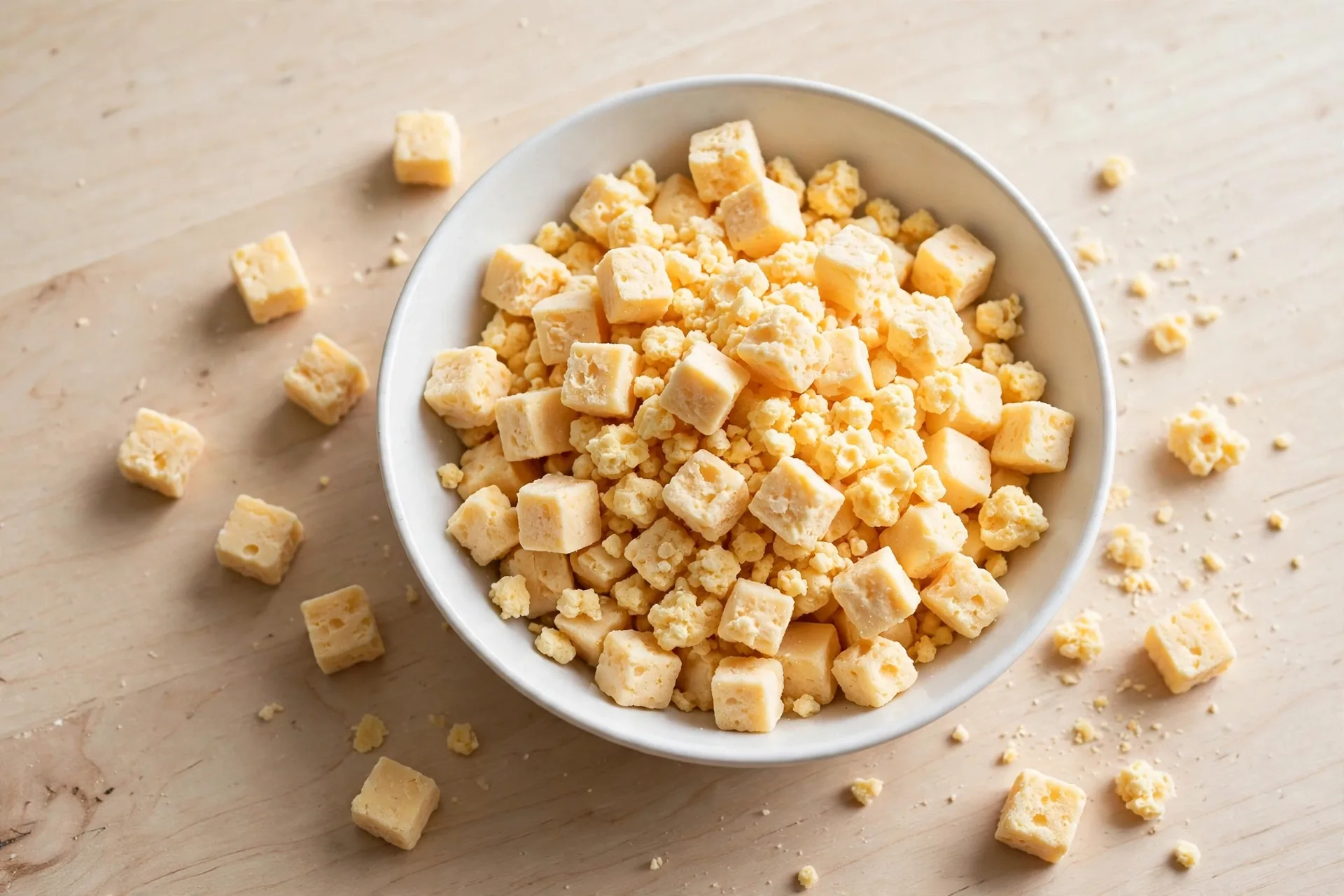
Which cheeses suit freeze drying
Not every cheese behaves the same in a freeze dryer. The cheeses that work best are the ones with a firm body and a moderate moisture level, cut into pieces that hold their shape.
Hard cheeses
Hard cheeses such as cheddar, gouda and parmesan are the usual starting point. They cut cleanly into cubes, slices or shreds, keep their edges through freezing and drying, and come out crisp and flavourful.
Semi-hard cheeses
Semi-hard cheeses — the family that includes many everyday table cheeses — also work well when they are firm enough to cut cleanly. The test is simple: if the cheese holds a clean cut at room temperature and does not smear on the knife, it is usually a good candidate.
Very soft and high-moisture cheeses
Very soft, high-moisture cheeses are the hardest to freeze dry. Fresh cheeses and very soft ripened cheeses can collapse, stick together or turn greasy. They are not impossible, but they need testing on a small batch first.
How the freeze drying process works
Freeze drying has three stages — freezing, primary drying under vacuum, and final drying — and the cheese never gets hot.
1. Freezing
The cut cheese is spread on trays and frozen solid. Freezing locks the pieces in shape, so a cube stays a cube through the rest of the process.
2. Primary drying — sublimation
Once the chamber is sealed, the vacuum pump pulls the pressure down. Under low pressure, the ice inside the cheese turns straight into vapour without melting — a change called sublimation. The vapour is drawn away and frozen onto the cold surfaces of the condenser. This is the stage that removes most of the water and leaves the open, porous structure behind — the reason a freeze dried cube feels so light.
3. Final drying
A gentle warming stage removes the last traces of water still bound inside the cheese. The temperature stays well below anything that would melt the fat or brown the surface, and the chamber stays under vacuum until the batch is done.
No fixed cycle time applies: the length of a batch depends on the cheese, the piece size, the load on the trays and the dryer itself. Treat any time quoted for a different product as a starting point, not a figure to plan around.
Texture and flavour after drying
Freeze dried cheese keeps its flavour. The flavour is the same cheese, concentrated by the removal of water — a cube tastes like the cheese it came from, only more intense in the bite. Because the process runs cold and under vacuum, the characteristic notes of the cheese survive in a way heat drying cannot match.
The texture changes completely. Fresh cheese is soft, moist and elastic; freeze dried cheese is crisp, light and crumbly. A cube snaps between the teeth and melts away quickly, and shreds shatter into flakes. That change is the product: it is what makes freeze dried cheese work as a snack and as a topping that stays crisp.
Fat needs attention. Cheese carries a good deal of fat, and fat does not leave with the water. In a well-run batch the fat stays inside the piece, but in a batch that runs too warm, or with a very rich cheese, oil can seep to the surface and soften the crisp texture.
Where freeze dried cheese is used
Freeze dried cheese sells in several forms, and each one points at a different buyer.
- Snack cubes: cubes or bite-size pieces sold on their own as a savoury snack, or mixed into snack blends with nuts, seeds and dried fruit.
- Salad and meal toppings: shreds and crumbles scattered over salads, soups and baked dishes, where they stay crisp until they meet moisture.
- Soup and sauce ingredient: cubes and shreds that soften and melt into hot soups, sauces and ready meals, adding cheese flavour without the weight or the cold chain of fresh cheese.
- Cheese powder: milled freeze dried cheese used as a seasoning — dusted over snacks, blended into bakery mixes, or stirred into sauces.
- Food service and catering: light, shelf-stable cheese for kitchens that want cheese flavour on hand without refrigeration and without waste from opened blocks.

Tray loading and piece size
Piece size decides how evenly a batch dries. Cut the cheese into pieces of one size — cubes of one size, shreds of one thickness — so every piece dries at the same rate. Mixed sizes in one batch leave small pieces over-dried and large pieces damp in the middle.
Spread the pieces in a single, even layer on each tray, with small gaps between them. Pieces that touch or overlap stick together as they dry, and piled pieces trap moisture in the middle of the pile.
Do not overload the trays to save a cycle. A tray loaded past its working depth dries unevenly, and the pieces in the middle come out soft while the edges are done. Check the tray size before you plan your output, and run your trial at the load you intend to use in production.
Packaging and storage
Freeze dried cheese must be protected from moisture. The dry, porous pieces pick up water from the air quickly, and a piece that has picked up moisture loses its crispness and can soften or clump. Pack in moisture-proof packaging, seal it well, and keep the packs dry and cool.
Pack soon after drying, while the pieces are still dry, and do not leave trays standing open in a humid room. If the pack is opened, close it again promptly and use the contents soon — the pieces will not stay crisp in open air.
Storage conditions and labelling rules differ by market, so check the rules of your target market before you print a pack.
What to check before buying a dryer for cheese
Cheese is a demanding product for a freeze dryer: it is fatty, it must keep its shape, and it is sold on flavour. Before you buy, check the dryer against the product, not against a brochure.
- Tray area and tray count: the tray area decides how much cheese you can load per batch. Compare models on tray area, not only on chamber size.
- Temperature control: look for tight, even control of the shelf temperature, so every tray dries at the same rate.
- Vacuum system: a reliable vacuum pump and a cold condenser make sublimation work. Ask how the condenser is defrosted between batches.
- Controls and repeatability: a PLC with a touchscreen that stores recipes lets the same batch repeat from one operator to the next.
- Cleaning: cheese leaves fat and crumbs. Ask how the chamber, shelves and trays are cleaned between products.
- Trial batch: run a trial batch of your own cheese on the machine before you buy. Colour, shape, crispness and any oil on the surface are all visible in one tray.
QS freeze dryer models
| Model | Tray area | Trays | Power | Dimensions (mm) | Batch capacity |
|---|---|---|---|---|---|
| QS-FD-20 | 20.16 sqm | 84 | 35kW | 4500x1300x1400 | ~200kg/batch |
| QS-FD-100 | 103.68 sqm | 432 | 135kW | 7000x4000x2300 | ~1t/batch |
| QS-FD-200 | 207.36 sqm | 864 | 135kW | 12000x4000x2300 | ~2t/batch |
- Chamber: SUS304 square chamber, -60°C, R404A/507 refrigeration.
- Temperature control: ±0.1°C, max 80°C.
- Control: Siemens S7-200 PLC.
- Vacuum pumps: Roots + screw vacuum pumps.
- Seals: food-grade silicone seals.
- Warranty: 1-year warranty; lead time approx. 3 months.
Common mistakes to avoid
Most poor batches come from the same few oversights.
- Cutting mixed sizes in one batch, so small pieces over-dry and large pieces stay damp inside.
- Loading trays in piles or letting pieces touch, so they stick together and trap moisture.
- Leaving trays open in humid air after drying, so the pieces soften before they are packed.
- Packing in packaging that lets moisture in, so crisp cubes turn soft on the shelf.
- Choosing a dryer by chamber size alone, without checking tray area and temperature control.
- Copying settings from another product without testing them on your own cheese.
Frequently asked questions
Which cheeses freeze dry best?
Hard and semi-hard cheeses in cubes, slices or shreds hold their shape best and come out crisp and flavourful. Very soft, high-moisture cheeses are harder to handle — they can collapse, stick together or turn greasy — so test them on a small batch first.
Does freeze dried cheese taste like fresh cheese?
The flavour stays recognisable and is more concentrated, because the water is gone. The texture changes completely: freeze dried cheese is crisp, light and crumbly rather than soft and elastic, so it eats as a snack or a topping rather than as fresh cheese.
How should freeze dried cheese be stored?
Keep it in sealed, moisture-proof packaging, stored dry and cool and away from direct light. Once a pack is opened, close it again promptly and use the contents soon, because the pieces pick up moisture from the air and lose their crispness.
Can I test freeze drying with my own cheese before buying a dryer?
Yes — and you should. Run a small trial batch of your own cheese, in the cut you plan to sell, and check the shape, the crispness and whether any oil seeps to the surface.
Talk to us about your freeze drying line
Tell us your product and target output — we will help you size the dryer. Explore the range on our freeze dryer page.
Specifications are for reference only and are subject to the final supplied equipment.